

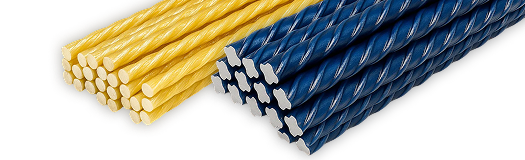
In response to the question: "Which is better – fiberglass or metal rebar?", let us focus on the characteristics of composite products. Through comparison, it becomes clear that non-metallic "ETIZ Kompozit" rebar outperforms in several aspects at once.
Matches Steel in Strength
ETIZ 6 MM – A500 d10mm
ETIZ 8 MM – A500 d12mm
ETIZ 10 MM – A500 d14mm
ETIZ 12 MM – A500 d18mm
Recommended for Replacing Steel in Structures on Elastic Foundations:
ETIZ 6 MM – A500 d8mm
ETIZ 8 MM – A500 d10mm
ETIZ 10 MM – A500 d12mm
ETIZ 12 MM – A500 d14mm
MINIMUM WEIGHT
Fiberglass or composite rebar is 4 times lighter than metal products of the same diameter. This reduces logistics costs when delivering rebar to a construction site, and also allows for savings on loading and unloading.
STRENGTH
"ETIZ Kompozit" rebar is characterized by high tensile strength – at least 1200 MPa. This indicator is 3-4 times higher than that of its metal counterpart, thus requiring a smaller reinforcement area for the structure. Consequently, the diameter of the rebar used is reduced.
100% PHYSICAL MEMORY
Fiberglass rebar becomes straight after being unwound from a coil. Products with a diameter of 6-10 mm are packaged in 50-meter coils, which reduces rebar waste when working with concrete products 6 meters or longer. Fiberglass rebar is the optimal reinforcing material for asphalt pavement, as it reduces rutting during operation.
RESISTANCE TO AGGRESSIVE ENVIRONMENTS
It is recommended to use composite rebar in the construction of foundations, bridges, and shore-protection concrete structures. "ETIZ Kompozit" products retain their properties when in contact with water, so buildings can be located in areas close to the groundwater table.
MINIMAL THERMAL CONDUCTIVITY
Unlike metal rebar, fiberglass products provide additional protection against cold penetration. Thanks to its low thermal conductivity, the composite material is used in the manufacture of flexible connections in monolithic and other types of construction.
EASE OF PROCESSING
Cutting fiberglass rebar is performed directly at the construction site using common tools: from a hacksaw to an angle grinder with a metal or ceramic cutting disc.
WIDE RANGE OF APPLICATIONS
Due to its complete radio transparency and lack of electrical conductivity, this material is used in the construction of not only residential buildings but also special-purpose concrete structures – medical centers, defense industry facilities, and thermal power plants.
For a clear understanding of the difference between steel and fiberglass composite rebar, we invite you to review the data in the specially prepared table below.
Comparison of Composite Rebar "ETIZ Kompozit" and Steel Rebar Class A-III (A400C) GOST 5781-82
| Characteristics | Composite Rebar "ETIZ Kompozit" | Steel Rebar Class A-III (A400C) GOST 5781-82 |
|---|---|---|
| Material | Glass fibers 16-24 microns, bonded with polymer | Steel 25G2S, 35GS, etc. |
| Ultimate tensile strength, MPa | at least 1000 | 390 |
| Modulus of elasticity, MPa | at least 55,000 | 200,000 |
| Relative elongation, before loss of elastic deformation, % | 2.5 | 0.18 |
| Behavior under load | Straight line with an elastic-linear relationship under load up to failure | Curved line with a yield plateau under load |
| Coefficient of linear expansion α×10⁻⁶/°C |
6-10 longitudinal 21-23 transverse |
11.7 |
| Corrosion resistance to aggressive environments | Rust-proof material that retains its properties even in the alkaline environment of concrete | Releases rust products |
| Thermal conductivity | Does not conduct heat | Conducts heat |
| Electrical conductivity | Dielectric | Conductive material |
| Environmental friendliness | Does not release harmful or toxic substances during storage and use | Environmentally friendly material |
| Durability | At least 80 years | Service life is specified in special building codes |
| Density, t/m³ | 2.1 | 7.8 |